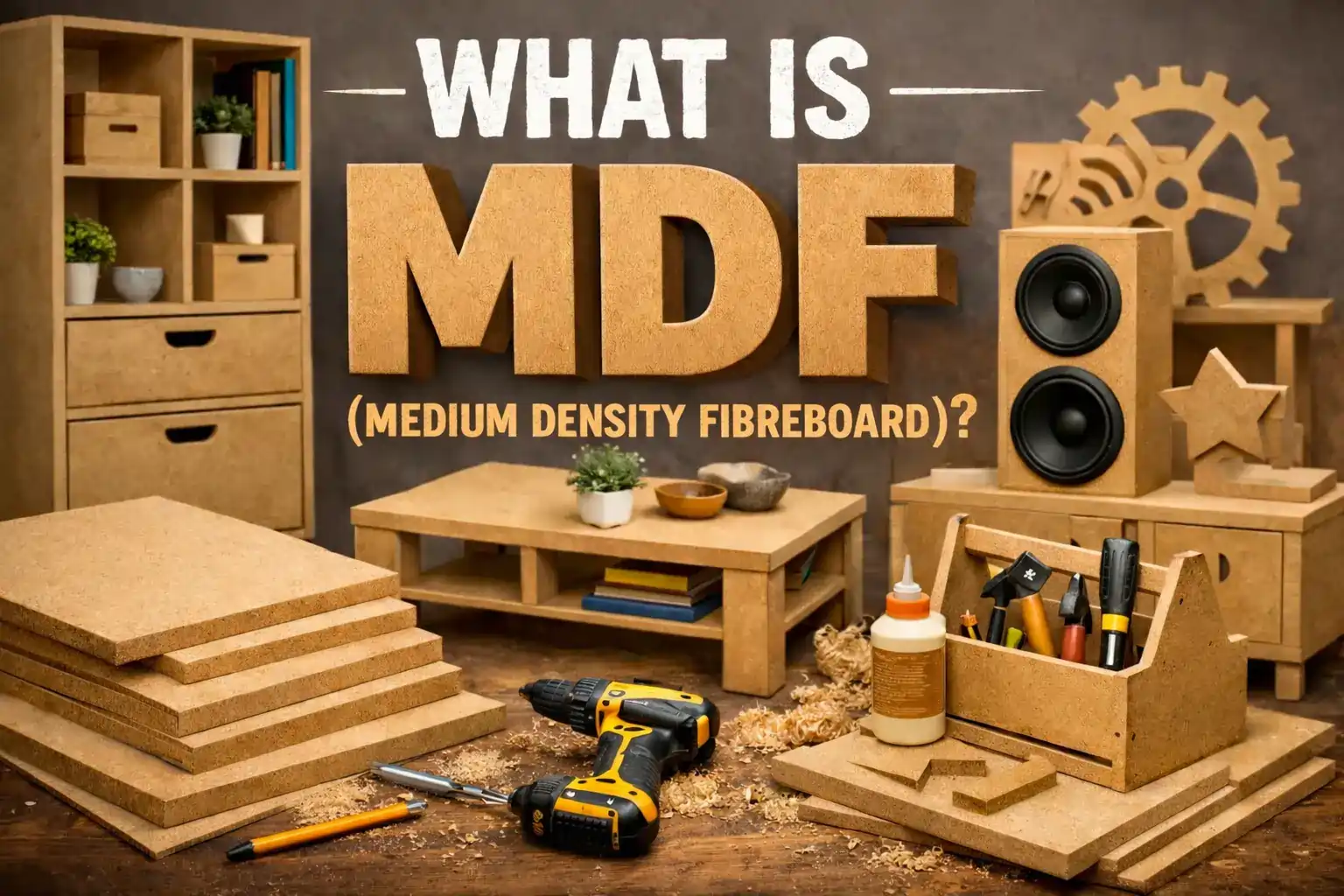
1️⃣ What Is MDF?
MDF (Medium Density Fibreboard) is an engineered wood product made by breaking down hardwood or softwood residuals into fine wood fibres, combining them with wax and resin binders, and compressing them under high temperature and pressure to form dense, smooth panels.
In simple terms:
 MDF is made from wood fibres that are glued and pressed together into strong, uniform sheets.
Unlike natural wood, MDF does not have knots, grain patterns, or inconsistencies. This makes it ideal for applications where a smooth surface finish is required.
2️⃣ How Is MDF Manufactured?
Understanding the manufacturing process helps explain why MDF performs the way it does.
 Step 1: Wood Collection
Wood chips, sawdust, and wood waste from sawmills are collected. This makes MDF a relatively resource-efficient product.
 Step 2: Fiber Breakdown
The wood is broken down into fine fibres using a defibrator machine.
 Step 3: Resin & Wax Mixing
The fibres are mixed with:
- Urea-formaldehyde resin (most common binder)
- Wax for moisture resistance
 Step 4: Forming the Mat
The fibre mixture is formed into a thick mat.
 Step 5: Hot Pressing
The mat is compressed under high pressure and heat to create dense boards.
 Step 6: Cooling & Cutting
The boards are cooled, trimmed, and sanded to achieve smooth surfaces.
 The result? A uniform, dense, flat sheet that is ready for finishing.
3️⃣ Key Properties of MDF
Here are the characteristics that define MDF:
✔ Smooth Surface – Perfect for painting, laminating, and veneering.
✔ Uniform Density – No knots, cracks, or natural defects.
✔ Easy to Cut and Machine – Ideal for CNC cutting and intricate designs.
✔ Consistent Thickness – Reliable for modular furniture manufacturing.
✔ Cost-Effective – Generally cheaper than plywood and solid wood.
4️⃣ Types of MDF
MDF is not just one product. It comes in various types designed for different applications.
🟢 1️⃣ Standard MDF
- Most common type
- Used for furniture and interior applications
- Not moisture resistant
🟢 2️⃣ Moisture-Resistant MDF (MR MDF)
- Treated to resist humidity
- Suitable for kitchen cabinets and wardrobes
- Often green in colour for identification
🔴 3️⃣ Fire-Retardant MDF (FR MDF)
- Slows down fire spread
- Used in commercial spaces and offices
- Usually red or blue coloured core
🌧 4️⃣ Exterior Grade MDF
- Specially treated for higher moisture resistance
- More expensive than regular MDF
🎨 5️⃣ Pre-Laminated MDF
- Comes with decorative laminate on both sides
- Saves finishing time
- Used in ready-made furniture
5️⃣ Common MDF Thickness Options
MDF boards are available in various thicknesses depending on usage:
- 2.5 mm
- 3 mm
- 4 mm
- 6 mm
- 9 mm
- 12 mm
- 16 mm
- 18 mm
- 25 mm
Each thickness serves a specific purpose in furniture and interior design.
6️⃣ 📊 MDF Price Range in India (Thickness-wise)
Standard MDF Board (8 ft × 4 ft Sheet)
Thickness | Common Uses | Approx Price Range (₹ per sheet) |
2.5 mm | Drawer bottoms, cabinet backs | ₹500 – ₹700 |
3 mm | Lightweight panels, backing boards | ₹600 – ₹850 |
4 mm | Wall panelling, partitions | ₹750 – ₹1,000 |
6 mm | Decorative panels, partitions | ₹1,000 – ₹1,400 |
9 mm | Shelves, small furniture | ₹1,400 – ₹1,900 |
12 mm | Drawer boxes, light carcass work | ₹1,900 – ₹2,500 |
16 mm | Wardrobes, modular furniture | ₹2,600 – ₹3,200 |
18 mm (Most Popular) | Cabinets, tables, wardrobes | ₹2,900 – ₹3,800 |
25 mm | Heavy-duty furniture, tabletops | ₹4,200 – ₹5,500 |
7️⃣ Advantages of MDF
Here’s why MDF dominates the furniture industry:
💰 Budget-Friendly
Costs significantly less than solid wood.
🎨 Smooth Finish
Ideal for:
- Paint
- PU coating
- Veneers
- Laminates
🔒 No Warping or Cracking
Unlike natural wood.
🖥 Perfect for CNC Designs
Used in decorative wall panels and jali designs.
✨ Easy to Customize
Can be cut into intricate shapes.
8️⃣ Disadvantages of MDF
MDF is excellent—but not perfect.
❌ Not Waterproof – Standard MDF swells when exposed to water.
❌ Heavy – Denser than plywood.
❌ Moderate Screw Holding Capacity.
❌ Dust Production – Cutting releases fine dust.
9️⃣ MDF vs Plywood: Which Is Better?
Feature | MDF | Plywood |
Surface Finish | Very Smooth | Slight Grain |
Strength | Moderate | High |
Moisture Resistance | Low | Better |
Price | Cheaper | Costlier |
Weight | Heavy | Lighter |
Screw Holding | Moderate | Strong |
👉 Choose MDF for smooth painted furniture.
👉 Choose plywood for structural strength and moisture resistance.
🔟 Applications of MDF
MDF is widely used in:
✔ Modular kitchen cabinets
✔ Wardrobes
✔ TV units
✔ Wall panelling
✔ Decorative partitions
✔ Office furniture
✔ Door skins
✔ Speaker boxes
✔ Exhibition stalls
Its smooth surface makes it perfect for painted finishes.
1️⃣1️⃣ MDF Finishing Options
✔ Laminate Finish
✔ PU Paint Finish
✔ Acrylic Finish
✔ Veneer Finish
✔ Membrane Finish
1️⃣2️⃣ Is MDF Environmentally Friendly?
MDF uses recycled wood waste, reducing logging pressure. However:
- Some MDF contains formaldehyde.
- Look for E0 or E1 grade MDF for low emissions.
- Many brands now offer eco-friendly MDF options.
1️⃣3️⃣ Maintenance Tips
To increase MDF lifespan:
✔ Avoid direct water contact
✔ Use proper edge banding
✔ Clean with dry cloth
✔ Avoid heavy loads on thin sheets
✔ Use quality screws and adhesives
With proper care, MDF furniture can last 8–15 years or more.
1️⃣4️⃣ Where Should You Use MDF?
✅ Best For:
✔ Bedrooms
✔ Living rooms
✔ Office interiors
✔ Decorative work
❌ Avoid In:
✖ Bathrooms
✖ Outdoor areas
✖ High-moisture zones
1️⃣5️⃣ Final Thoughts
MDF (Medium Density Fibreboard) has transformed the furniture and interior design industry. It offers a perfect combination of affordability, smooth finish, and design flexibility.
If your priority is:
✔ Smooth painted finish
✔ Budget-friendly option
✔ CNC or decorative design work
👉 MDF is an excellent choice.
📌 Quick Summary
✔ Engineered wood made from wood fibres
✔ Smooth, dense, and cost-effective
✔ Available from 2.5 mm to 25 mm thickness
✔ Best for interior furniture
✔ Not ideal for high-moisture areas unless MR grade
If you’re planning furniture or interior work, choosing the correct thickness and grade of MDF can significantly impact durability, appearance, and cost.