

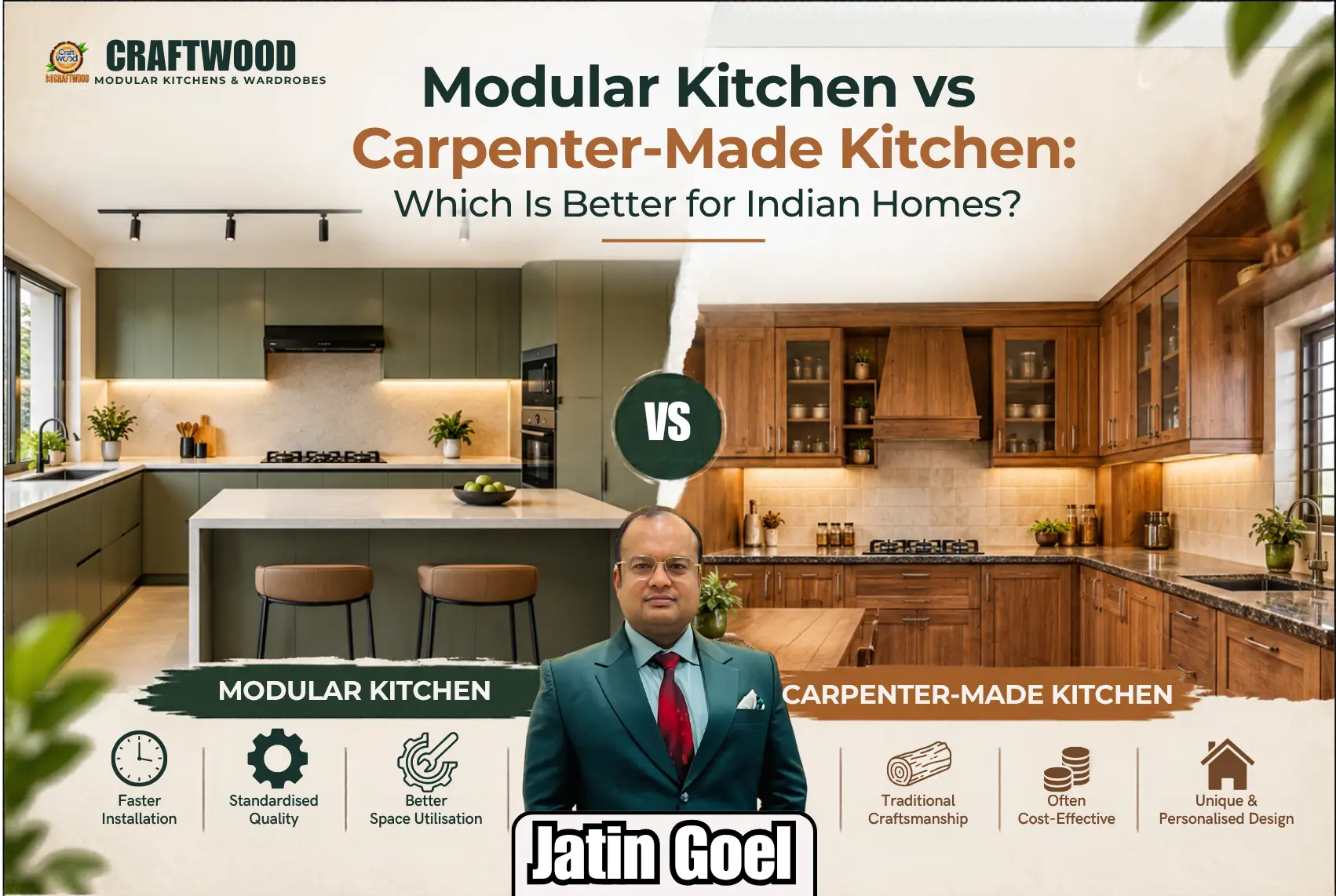
Designing a kitchen is exciting, but it also comes with some important decisions. You need to think about the layout, storage, materials, finishes, hardware, budget, and how comfortably the kitchen will work in everyday life. One of the most common decisions homeowners face is choosing between a modular kitchen and a kitchen built by a local carpenter. The debate around Modular Kitchen vs Carpenter-Made Kitchen in India is not as simple as saying that one option is always better. Both can create a functional and attractive kitchen, but the way they are designed, manufactured, installed, and maintained can be quite different.For Indian homes, where kitchens are used extensively and storage requirements can vary from one family to another, understanding these differences can help you make a smarter decision. So, instead of choosing only based on price or appearance, let’s compare both options in detail.
What is modular kitchen
A modular kitchen is created using individual cabinet units, commonly called modules.these modules are designed according to the available kitchen space and are generally manufactured in a factory before being assembled and installed at your homes.A modular kitchen can include base cabinets, overhead cabinets, drawers, tall units, corner units, pantry storage, cutlery organisers, bottle pull-outs, and several other functional storage solutions.Since much of the cutting, drilling, and finishing is done using machines in a controlled manufacturing environment, the dimensions and finishing of different components can be more consistent.
Homeowners can also select materials, finishes, colours, hardware, and storage accessories based on their requirements and budget.This factory-manufacturing approach is one of the major points to understand while comparing modular kitchen vs carpenter made kitchen in India. If you also want to know how much a modular kitchen cost in India, you can also read our other blog on this topic; click here
What Is a Carpenter-Made Kitchen?
A carpenter-made kitchen is usually constructed mainly at the site. A carpenter measures the available area, cuts the selected boards, prepares cabinets, fits shutters, and installs the required hardware.
One of the biggest advantages of this method is flexibility.If you want to change a cabinet dimension or make a small modification during the construction process, it may be easier to discuss it directly with the carpenter.However, the final quality can depend heavily on the carpenter’s experience, tools, workmanship, and attention to detail. A highly skilled carpenter can produce excellent results. On the other hand, inconsistent workmanship can sometimes result in alignment problems, uneven finishes, or differences between different cabinet sections.Therefore, the carpenter you select plays a major role in the final outcome.
Modular Kitchen vs Carpenter-Made Kitchen in india: quick comparison
Factor | Modular Kitchen | Carpenter-Made Kitchen |
Manufacturing | Mostly factory-manufactured | Mostly constructed on-site |
Finishing | More standardised | Depends on carpenter’s workmanship |
Customisation | High | Very high |
Installation | Generally faster on-site | Can require more on-site work |
Site disturbance | Comparatively lower | More cutting and construction at home |
Storage | Planned storage solutions | Customised according to requirements |
Hardware | Can use standard/branded systems | Depends on selected hardware |
Warranty | Depends on manufacturer | Depends on carpenter/vendor |
After-sales support | Usually more structured | Depends on carpenter availability |
Irregular spaces | Requires detailed planning | Easier to adjust during construction |
This comparison gives you a quick overview, but several factors need to be considered before making the final decision.
1. Modular Kitchen vs Carpenter-Made Kitchen: Design and Overall Appearance
The appearance of the kitchen is important because it occupies a major visual area of the home.Modular kitchens generally offer a clean and contemporary appearance. Machine processing can help maintain uniformity across shutters, drawers, cabinets, and edges.There are also plenty of finish options available. Depending on the manufacturer, homeowners can choose laminate, acrylic, matte, gloss, wood-inspired finishes, and several colour combinations. This makes it easier to match your kitchen with the overall interior theme of your home.
A carpenter-made kitchen can also look premium when handled by an experienced professional. However, achieving consistent alignment and finish across every component depends on the carpenter’s tools and skill. When comparing modular vs. carpenter-made kitchens in India, homeowners who prefer a more standardised, uniform finish may find modular manufacturing appealing.
2. Customisation and Flexibility
Many people assume that modular kitchens have limited customisation.That isn’t necessarily true.Modern modular kitchens provide considerable flexibility when it comes to layouts, cabinet sizes, colours, finishes, storage configurations, and accessories. For example, you can include deep drawers for utensils, dedicated spice storage, tall pantry cabinets, bottle pull-outs, corner solutions, and overhead storage according to your cooking habits. However, modular kitchens still work within planned manufacturing specifications.
Carpenter-made kitchens can provide greater flexibility when dealing with unusual dimensions, uneven walls, difficult corners, or highly specific design requirements. Because the carpenter is working directly at the site, adjustments may sometimes be easier to make during construction. So, if your kitchen has an unconventional layout, carefully discuss the possibilities with both types of providers before deciding.
3. Modular Kitchen vs Carpenter-Made Kitchen: Quality and Finishing
Quality is one area where homeowners should avoid making assumptions.A kitchen doesn’t automatically become high-quality simply because it is modular. Similarly, a carpenter-made kitchen isn’t automatically stronger just because it is constructed manually. The quality depends on several things, including:
- Core material
- Board thickness
- Hardware
- Hinges
- Drawer channels
- Edge finishing
- Installation quality
- Moisture protection
- Overall workmanship
One advantage of modular manufacturing is consistency. Machine-based cutting, drilling, and edge finishing can provide greater precision across different components. In a carpenter-made kitchen, the result depends more directly on individual workmanship. Therefore, while evaluating modular kitchen vs carpenter made kitchen in India, don’t look only at the finished photos. Ask about the actual materials and hardware being used behind those attractive shutters.
4. Modular Kitchen vs Carpenter-Made Kitchen : Installation Time and Convenience
Kitchen renovation can disturb your normal routine, especially if you’re already living in the house.With a traditional carpenter-made kitchen, much of the cutting, assembly, and fitting may happen directly at your home. This can result in dust, noise, tools, boards, and workers occupying the area during the construction period. The modular process works differently. Measurements and design planning happen first. Once the design is approved, major components are manufactured away from your home and later brought to the site for installation. The biggest benefit here is convenience. Since most of the preparation happens away from your home, there is usually less cutting, drilling, and assembly happening inside the kitchen area.
Of course, a modular kitchen still takes time to complete. Measurements need to be taken, the design has to be approved, components need to be produced, and everything then has to reach the site for installation. The difference is that much of this work follows a planned process, which can make the final installation easier to manage.
5. Making Better Use of Kitchen Space
Good storage isn’t about adding as many cabinets as possible. It’s about having the right place for the things you use every day. Think about a typical Indian kitchen. There are pressure cookers, kadais, containers, masala boxes, plates, groceries, bottles, appliances, cleaning supplies, and plenty of other items that need their own space. This is where planning becomes important. With a modular kitchen, you can decide how different areas will be used before the cabinets are manufactured. Instead of ending up with oversized shelves where everything gets stacked together, storage can be planned around your daily routine.
For example, you might choose:
– Deep drawers for large pots and pans
– A separate cutlery section
– Pull-outs for bottles and jars
– Corner units to make use of difficult spaces
– A tall cabinet for groceries
– Extra crockery and appliances can be kept in upper cabinets
– The area beneath the sink can be turned into useful storage
– Frequently used utensils can have their own easy-to-reach drawers
Whether you choose modular furniture or traditional carpentry, storage should be planned around your routine. A carpenter can build customised cabinets as well, but the result depends on how clearly your needs are discussed before the work progresses. This matters even more when the kitchen is compact. In many city apartments, adding more cabinets isn’t the solution; using the available area intelligently is. That’s an important point to consider when looking at modular kitchens vs carpenter made kitchens in India.
6. Modular Kitchen vs Carpenter-Made Kitchen : Understanding the Real Cost of Your Kitchen
Kitchen budgets can be confusing because two kitchens of the same size can have completely different price tags.
Why?
Because you’re not paying only for cabinets.
The materials used inside them, shutter finish, hinges, channels, accessories, labour, installation, and several other details contribute to the final amount. This is also why assuming that a carpenter-made kitchen will always cost less can be misleading. It might be economical in some cases, but the specifications need to be considered before reaching that conclusion. Let’s say you receive two estimates. Two kitchen quotations can look similar at first and still cover very different things. That is why the total written at the bottom shouldn’t be the only thing you compare.
Say one contractor gives you a lower estimate. It may seem like the better deal, but check the details first. Does it include the same board, hardware, drawer channels, accessories and installation as the other quote? Are delivery and fitting included? What about the warranty?
These small differences can add up. Before finalising anything, check the cabinet and shutter material, finish, hinges, channels, internal fittings, installation charges and warranty. Also confirm whether countertop, plumbing or electrical work is part of the estimate or will be charged separately. This makes the modular kitchen vs carpenter made kitchen in India comparison much fairer. Two prices only make sense side by side when the specifications behind them are reasonably similar.
7. Modular Kitchen vs Carpenter-Made Kitchen: What Matters After the Kitchen Gets Old?
A kitchen can look excellent on the day it is installed. The real question is what happens after two, three or five years of regular cooking.
Think about what an Indian kitchen goes through on a normal day. There’s steam from the pressure cooker, oil around the cooking area, water near the sink and heavy kadais and utensils going in and out of drawers. Some cabinets may be opened twenty times before dinner is ready. Naturally, all of this causes wear over time.
This is where material and hardware choices start showing their importance.Take the sink cabinet. It is far more likely to come in contact with water than an overhead cabinet, so using the right material and protecting the edges matters. The same goes for a drawer filled with heavy cookware. A good-looking drawer isn’t much use if the channels aren’t suitable for the load. This applies to both types of kitchens. A modular kitchen made with poor materials can develop problems. A carpenter-made kitchen built carefully with suitable materials can last very well. The reverse can also be true. So don’t judge durability from the word “modular” or “carpenter-made” alone. Ask what is actually being used to build the kitchen.
8. And What If Something Breaks Later?
This part isn’t very exciting when you’re planning a new kitchen, but it can become important later. Cabinets and fittings are used every day. Eventually, a hinge may become loose, a drawer may need adjustment, or a shutter could get damaged.
Who do you call then?
With a modular kitchen company, there is usually a company or service team you can contact, although the actual support depends on the provider and its warranty terms. With a carpenter, it can be simpler if you already have a good relationship with the person who did the work. You can call them and get the problem fixed. The difficulty comes if the carpenter isn’t available a few years later. Neither arrangement is automatically better. You simply need to know what you’re signing up for. While comparing modular kitchen vs carpenter made kitchen in India, ask about service before placing the order, not after you need it.
So, Modular Kitchen vs Carpenter-Made Kitchen which is better?
Look at your kitchen first.
If the room has awkward corners, uneven dimensions or something very specific that needs to be built on-site, an experienced carpenter may be a sensible choice. It can also work well for homeowners who already have a carpenter they trust.
Modular kitchens suit a slightly different requirement. Much of the planning happens before production starts. You decide the layout, storage, finish and other details, and the cabinets are then manufactured accordingly before installation.For some homeowners, that structured process is convenient. Others prefer the flexibility of working directly with a carpenter. This is exactly why modular kitchen vs carpenter made kitchen in India doesn’t have the same answer for every house. Your space, budget and cooking habits matter more than the label attached to the kitchen.
Why Choose Craftwood?
Before planning a kitchen, it helps to forget about Pinterest-worthy designs for a moment and think about your current kitchen.
What annoys you about it?Maybe there’s never enough room for large utensils. Maybe packets and containers keep piling up on the counter. Perhaps you have a corner cabinet that technically provides storage but is so awkward to reach that you barely use it.These are the things worth solving in a new kitchen.At Craftwood, modular kitchen planning can take these everyday requirements into account. Storage, cabinet placement, hardware and finishes can be selected according to the available space and how the kitchen is expected to be used.
Someone who cooks twice a day may need a very different setup from someone who cooks occasionally. A family storing groceries for several weeks may need more pantry space, while a compact apartment kitchen may benefit more from smart vertical storage.A kitchen should look good, of course. But six months after installation, you’ll probably care more about whether you can find the pressure cooker without moving five other things first. That’s the kind of practicality worth planning for.
Conclusion
There isn’t much value in declaring every modular kitchen better than every carpenter-made kitchen, or vice versa. There are excellent and poorly built examples of both. A skilled carpenter can make excellent use of an unusual space and customize the work as it progresses. A good modular kitchen can give you planned storage, precise manufacturing and a more organised installation process.
When looking at modular kitchen vs carpenter made kitchen in India, spend less time asking which category is “best” and more time checking the kitchen you’re actually being offered.Look inside the cabinets. Ask which board is being used. Check the hinges and drawer channels. Ask about areas exposed to water. Read the warranty instead of simply hearing that a warranty exists. And then think about your normal day. Where will the pressure cooker go? Where will you keep the masalas you reach for every few minutes? Can two people move around comfortably? Will you have enough space when groceries arrive? Those questions aren’t glamorous, but they’re what decide whether a kitchen feels good to use. A good kitchen is the one you stop thinking about because everything is exactly where you need it. You can also see our work on Instagram about modular kitchens



1 Comment